

Short answer: the difference between a cabin bed vs mid sleeper vs high sleeper is height, and height decides the age it suits and the room it fits. A low cabin bed is about 50cm high, has no ladder and suits most school-age children. A mid sleeper is roughly 93 to 160cm high, uses a short ladder and is designed for children aged six and over. A high sleeper is about 180cm high, frees the whole floor for a desk and wardrobe, and needs a ceiling of around 2.4m. In our range, cabin beds start at £184.99, mid sleepers at £234.99 and our high sleeper is £448.99, all with free delivery to mainland England and Wales.
Last updated: 16 November 2026. Prices, sizes and stock are taken from our live product pages on that date.
A new bed is one of the few Christmas presents a child uses every single day, and a raised bed doubles as a bedroom makeover: storage, a desk or a den appear in the same floor space as an ordinary single. This guide explains which type suits which age and room, with real measurements from the beds we sell, so you can choose before the Christmas rush.
Cabin bed vs mid sleeper vs high sleeper at a glance
| Low cabin bed | Mid sleeper | High sleeper | |
|---|---|---|---|
| Overall height (our range) | 50–51cm (80–100cm with a desk or bookcase headboard) | 93–160cm | 180cm |
| Ladder | No | Yes, short ladder or built-in step | Yes, full ladder |
| Typical age | Primary school age to teens | Six and over | Six and over; best for older children and teens |
| What goes underneath | Drawers, cupboards, cubes | Cupboard, shelves, pull-out desk, toybox or a den | Full-height desk, wardrobe and shelving |
| Ceiling needed | Any | Standard ceilings, including many sloping ones | Around 2.4m or more |
| Mattress depth | Standard depth is fine (around 15–22cm) | Shallow, usually 15–20cm | Shallow, follow the bed’s instructions |
| Price from (Apley Beds) | £184.99 | £234.99 | £448.99 |
What is a cabin bed?
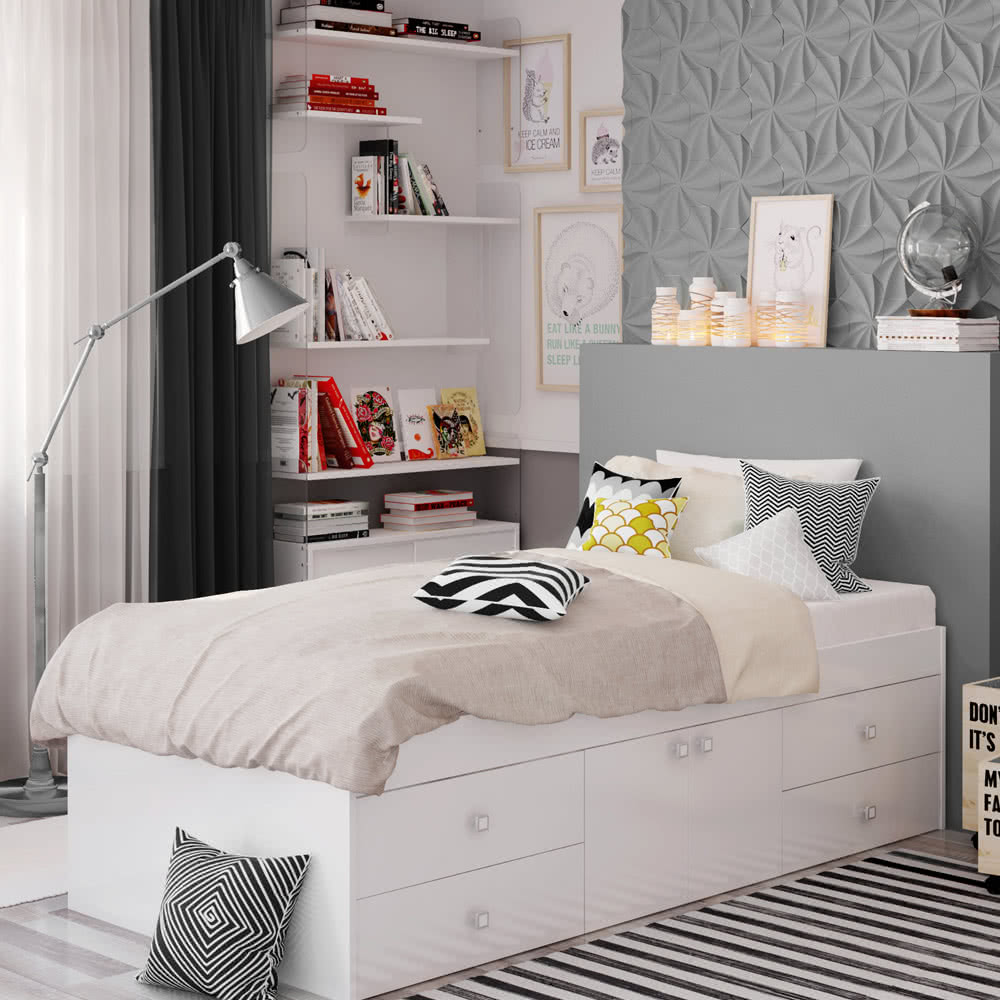
A cabin bed is a single bed raised a little off the floor so the base can hold storage. Because the sleeping surface stays close to normal bed height, there is no ladder and no guard rail to outgrow, so children can climb in and make the bed themselves. It is the safest step up from a toddler bed and the easiest raised bed to live with in a small room.
Our cabin beds are all UK single 3ft (90 x 190cm mattress). Examples:
- Kudl Flash Low Cabin Bed, white, £184.99: 50cm high, 96 x 196cm, with a centre storage cube and two open bays for baskets or the optional Flash drawers. Our lowest-priced cabin bed.
- Kudl Flash Cabin Bed with 2 Drawers, £226.99: the same frame with two large drawers on castors.
- Kudl Multi Drawer Cabin Bed, white, £295.99: 51cm high with four deep drawers (each roughly 62.5 x 48 x 19cm) and a central two-door cupboard, so it replaces a chest of drawers. Also in grey, oak effect and pink.
- Kudl Multi Drawer Cabin Bed with Bookcase Headboard, £331.99: adds a four-cubby bookcase headboard, 100cm high and 214cm long overall.
- Kudl Pilot Cabin Bed with Desk and Bookcase, £265.99: a low bed with a desk and bookcase built in alongside it, 80cm high and 137cm wide, for children who want a homework space without a ladder.
What is a mid sleeper?
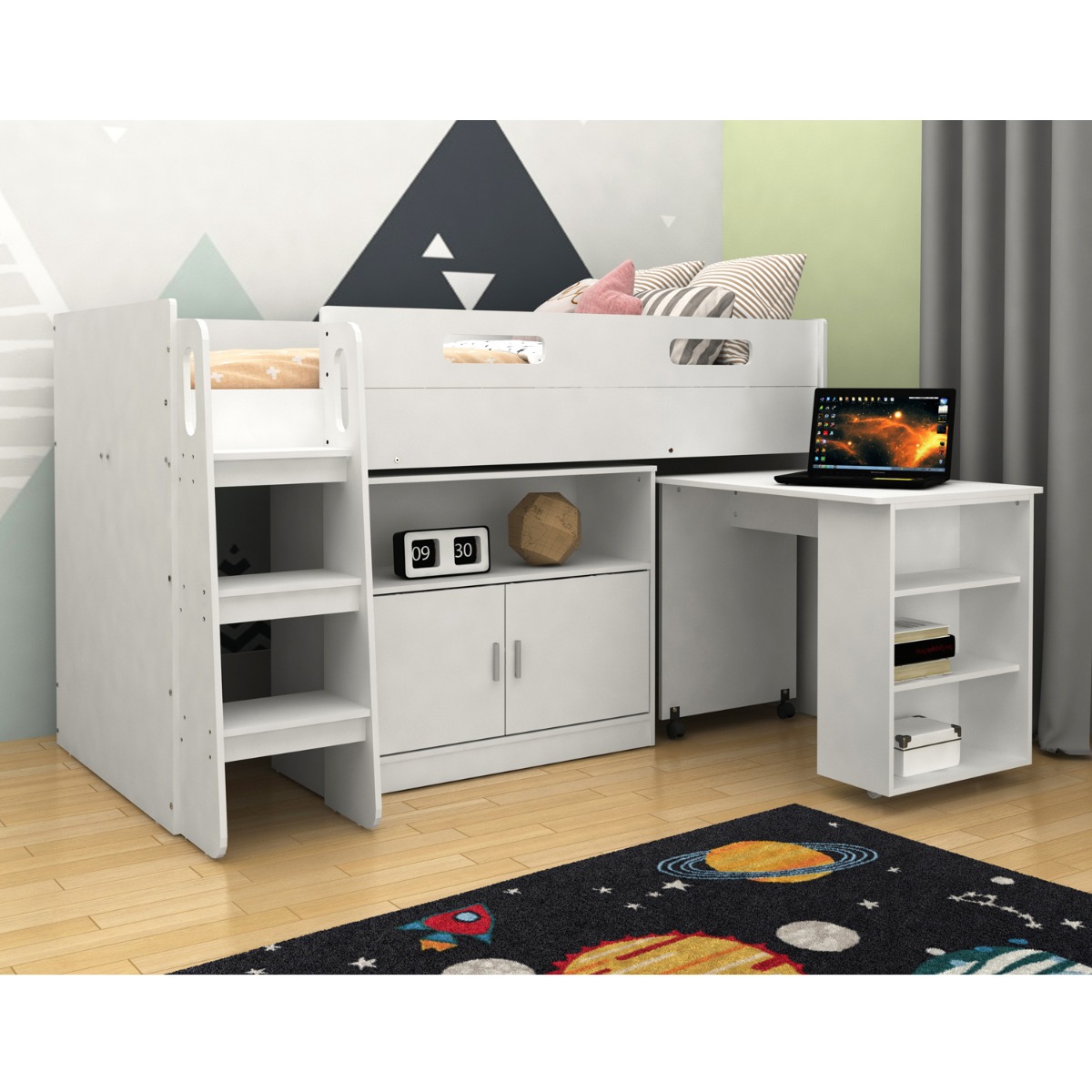
A mid sleeper lifts the bed high enough to make the floor underneath useful, but keeps your child within easy reach for stories and changing the sheets. A short ladder or a built-in step leads up to a sleeping deck surrounded by a guard rail. Underneath you get a cupboard and shelves, a pull-out desk, a toybox or simply open space for a reading den.
Raised beds with an upper sleeping surface are designed for children aged six and over, in line with the guidance that accompanies the EN 747 safety standard. Our mid sleeper beds cover a wide range of heights:
- Kudl Storage Mid Sleeper with Cupboard and Shelves, £269.99: only 93cm high, with a two-door cupboard, open shelving and a built-in step. It suits box rooms, sloping ceilings and shared rooms where a taller bed would block the window. White or oak effect.
- Kidsaw White Wooden Mid Sleeper House Bed, £234.99: a house-shaped frame with a roof outline, full-length guard rail and an angled ladder, with about 73.5cm of clear space underneath for a den. 160cm to the top of the roof frame.
- Kudl Children’s Mid Sleeper Bed, £309.99: 113.5cm high with 73.5cm of usable space underneath, sized to take Kidsaw’s matching desk with cube storage (£144.99) or a three-drawer chest.
- Kudl Mid Sleeper with Desk, Bookcase and Toybox, £379.99: 120cm high, with a mini desk, a cube bookcase and a toybox that slides out at tidy-up time.
- Kudl Storage Mid Sleeper with Pull-Out Desk and Cupboard, £400.99: 120cm high, with a desk on castors that rolls out for homework and slides back in at bedtime, plus a cupboard and open shelf. White or oak effect.
What is a high sleeper?
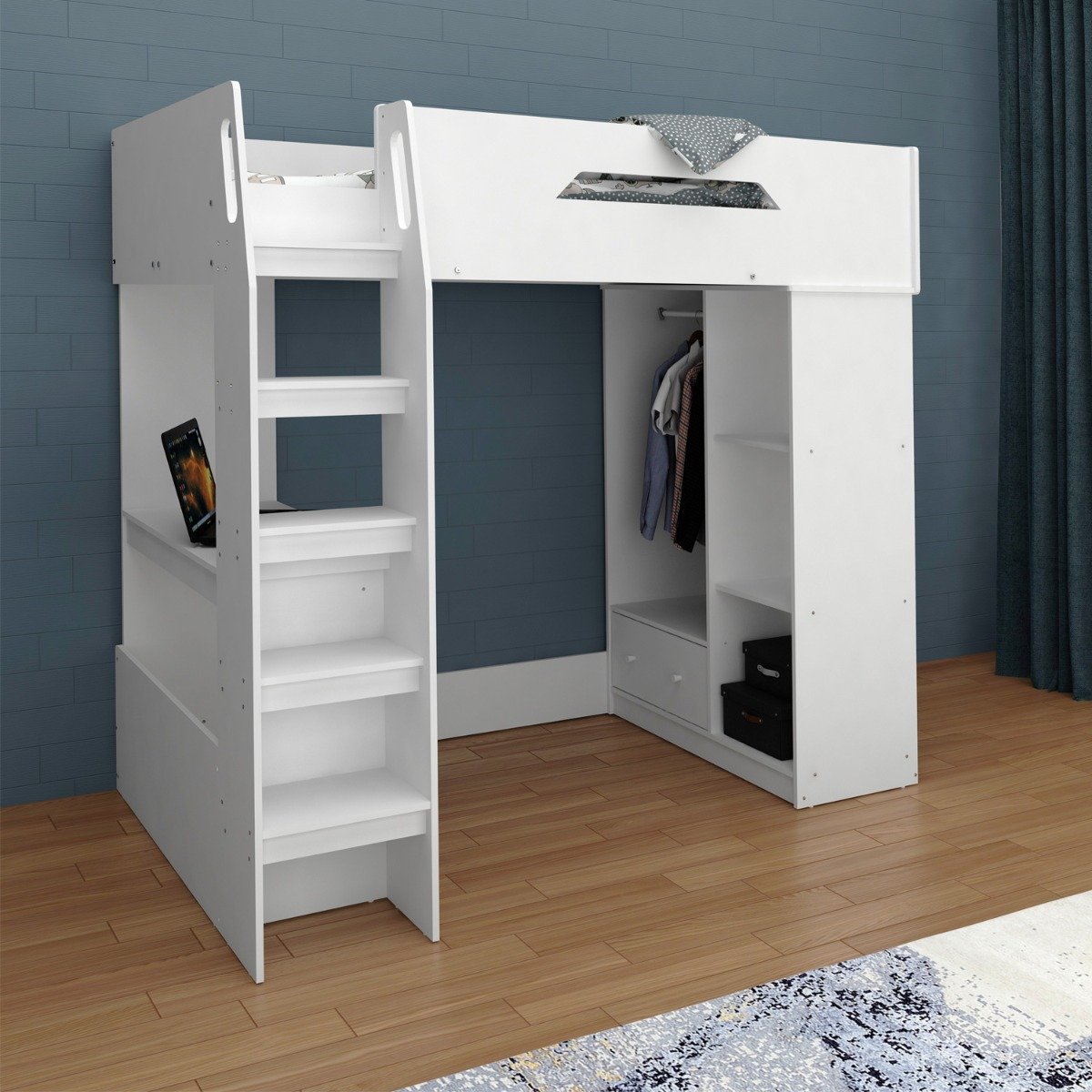
A high sleeper puts the bed at the top of a tall frame so the whole footprint underneath becomes a study or dressing area. It gives the most floor space of any children’s bed, which makes it a favourite for teenagers and for small bedrooms that need a proper desk.
The Kudl High Sleeper Bed with Desk, Wardrobe and Shelves, £448.99, is 180cm high, 123.5cm wide and 195cm long, with 144.1cm from the floor to the slats. Underneath is a desk with 75cm of knee height, a wardrobe section with a hanging rail and a drawer, and a tall set of shelves. Because the deck is so high, the room needs a ceiling of around 2.4m or more so your child can sit up in bed without bumping their head.
Which type suits which age?
- Moving out of a toddler bed: a low cabin bed. The sleeping surface is at normal height and there is nothing to climb. If your child is not ready for a full single yet, see our toddler beds.
- Six to about ten: a mid sleeper, especially a lower one (93 to 120cm). Children this age love the den underneath, and you can still reach the bed easily.
- Ten to teens: a taller mid sleeper with a desk, or a high sleeper if the ceiling allows. Older children need the desk space more than the den.
- Two children in one room: consider bunk beds and trundle beds. Our Kidsaw white wooden single with pull-out trundle (£241.99) keeps both children at floor level, and our wooden bunk beds start at £391.99.
These are general guidelines. The age printed in each bed’s instructions always takes priority, and the top deck of any raised bed is not suitable for children under six.
How much room and ceiling height do you need?
Measure three things before you order:
- Floor footprint. Most of our cabin beds and mid sleepers are 96 to 98cm wide and 195 to 198cm long. Beds with a bookcase headboard are about 214cm long, and some mid sleepers are wider (up to 115.8cm) because of the desk or ladder. The angled ladder on the house mid sleeper needs about 130cm at that end.
- Ceiling height. Add the bed height, the mattress depth and the sitting height of your child. For a high sleeper that means around 2.4m of ceiling. A low mid sleeper (93cm) works under most sloping ceilings.
- Clear space for drawers and desks. Drawers and pull-out desks need room in front of the bed to open fully, so allow at least 50 to 60cm of clear floor on that side.
Every product page lists the overall height, width and length in centimetres, and many include the supplier’s dimension drawing and assembly instructions.
Which mattress for a cabin bed, mid sleeper or high sleeper?
All the beds in this guide take a UK single 90 x 190cm mattress, and none includes one. The rule is simple: the higher the bed, the shallower the mattress, so the guard rail stays well above the sleeping surface.
- Low cabin beds have no guard rail, so a mattress of around 15 to 22cm is fine. The Kidsaw 1000 Pocket Sprung children’s single (20cm, £155.99) is our most supportive option.
- Mid and high sleepers usually take 15 to 20cm. The Kidsaw Reflex Foam children’s single (15cm, £133.99) has a zip-off washable cover, and the Kidsaw Deluxe Sprung (15cm, £142.99) is a sprung alternative.
- Bunk beds and the shallowest decks: the British-made, foam-free Jay-Be Simply Kids Anti-Allergy Bunk Mattress is 16cm deep and £88.99.
Always check the maximum mattress depth in your bed’s instructions. Bunk beds sold in the UK are built to BS EN 747, and a mattress that is too deep can make the guard rail ineffective. For more on mattress types, read our guide to pocket sprung mattresses.
Safety checklist for raised beds
- Top decks of mid sleepers, high sleepers and bunk beds are for children aged six and over.
- Use a mattress no deeper than the bed’s stated maximum.
- Keep the ladder clear of toys at night and never hang cords, belts or skipping ropes from the frame.
- Check and tighten the fixings every few months, especially in the first weeks after assembly.
- Place the bed away from windows, blinds with cords and ceiling lights.
Delivery, assembly and paying
Delivery is free to mainland England and mainland Wales, including Anglesey. We cannot deliver to Scotland, Northern Ireland, the Isle of Man, the Channel Islands, the Isle of Wight or the Isles of Scilly. Beds are delivered to your door flat packed for home assembly; raised beds are bigger builds, so plan on two adults. See our delivery information and the estimate on each product page, and order early if the bed is a Christmas present. You can spread the cost with Clearpay or PayPal Pay in 3 at checkout.
Frequently asked questions
What is the difference between a cabin bed and a mid sleeper?
Height and access. A cabin bed is about 50cm high with storage built into the base and no ladder. A mid sleeper is about 93 to 160cm high, has a ladder or step and a guard rail, and leaves space underneath for a desk, cupboard or den.
What age is a mid sleeper suitable for?
Mid sleepers, high sleepers and the top bunk are designed for children aged six and over. Low cabin beds suit younger school-age children because there is nothing to climb.
How high is a high sleeper bed?
Our Kudl high sleeper is 180cm high with 144.1cm from the floor to the slats, so the room needs a ceiling of around 2.4m.
Can an adult sleep in a cabin bed?
Our cabin beds take a standard UK single 90 x 190cm mattress, so they suit teenagers as well as children. They are designed and sold as children’s furniture, so follow the weight guidance in each bed’s instructions.
Do cabin beds and mid sleepers come with a mattress?
No. Each takes a UK single 90 x 190cm mattress sold separately, and we show suitable children’s mattresses on every bed’s page. Choose 15 to 20cm for mid and high sleepers.
Browse the full range: cabin beds, mid sleeper beds and all kids’ beds.